
Recurrence of pilonidal disease remains a significant challenge—even after surgery. Unlike first-time cases, recurrent disease is often more complex. This is mainly due to scarring from previous procedures and the presence of more irregular sinus tracts, which make further treatment more difficult.
Because of this, choosing the best surgical approach requires extra care. Techniques that work well for initial cases may not be as effective when the condition comes back. Each patient needs to be reassessed individually.
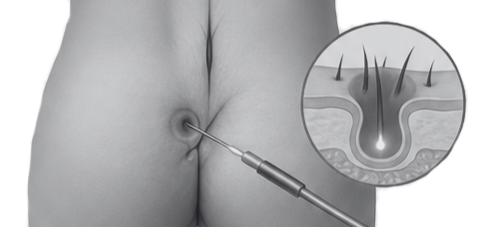
In recent years, a less invasive technique has gained attention: laser ablation. In this procedure, a thin catheter with a laser fiber at its tip is inserted into the sinus tract. The laser energy is then applied in a controlled way, destroying inflamed tissue and helping the tract close—without the need for large incisions.
Previous studies have already shown that this method is safe and effective for primary (first-time) pilonidal disease. But does it work just as well for recurrent cases?
To answer this question, researchers analyzed data from multiple previously published studies. They focused on patients with recurrent pilonidal disease treated with laser ablation, evaluating two main outcomes: healing rates and the occurrence of serious complications.
In total, 7 studies were included, involving 137 patients. Among them, 112 achieved healing after laser treatment—resulting in an overall success rate of about 82%.
When looking at follow-up duration, an interesting pattern emerged:
- Up to 12 months, healing rates were higher, around 87%
- With longer follow-up, rates dropped to approximately 75%
This suggests that while the treatment is quite effective in the short term, longer follow-up is important to better understand long-term outcomes.
The researchers also evaluated whether combining laser treatment with a technique called “pit picking” (removal of small skin openings) made a difference. The results showed no significant difference, indicating that both approaches may be similarly effective.
Overall, the findings are encouraging: laser ablation appears to be a safe and effective option for treating recurrent pilonidal disease—especially in the short term.
However, the authors emphasize that more high-quality studies with longer follow-up are still needed to confirm its long-term effectiveness.
Reference: Qin J, Xu X, Li Z, Jin L, Wang Z, Wu J. Efficacy and safety of laser ablation for recurrent pilonidal sinus: a systematic review and meta‑analysis. Int J Colorectal Dis. 2025 Feb 19;40(1):47. doi: 10.1007/s00384-025-04832-x. PMID: 39969579; PMCID: PMC11839847.